
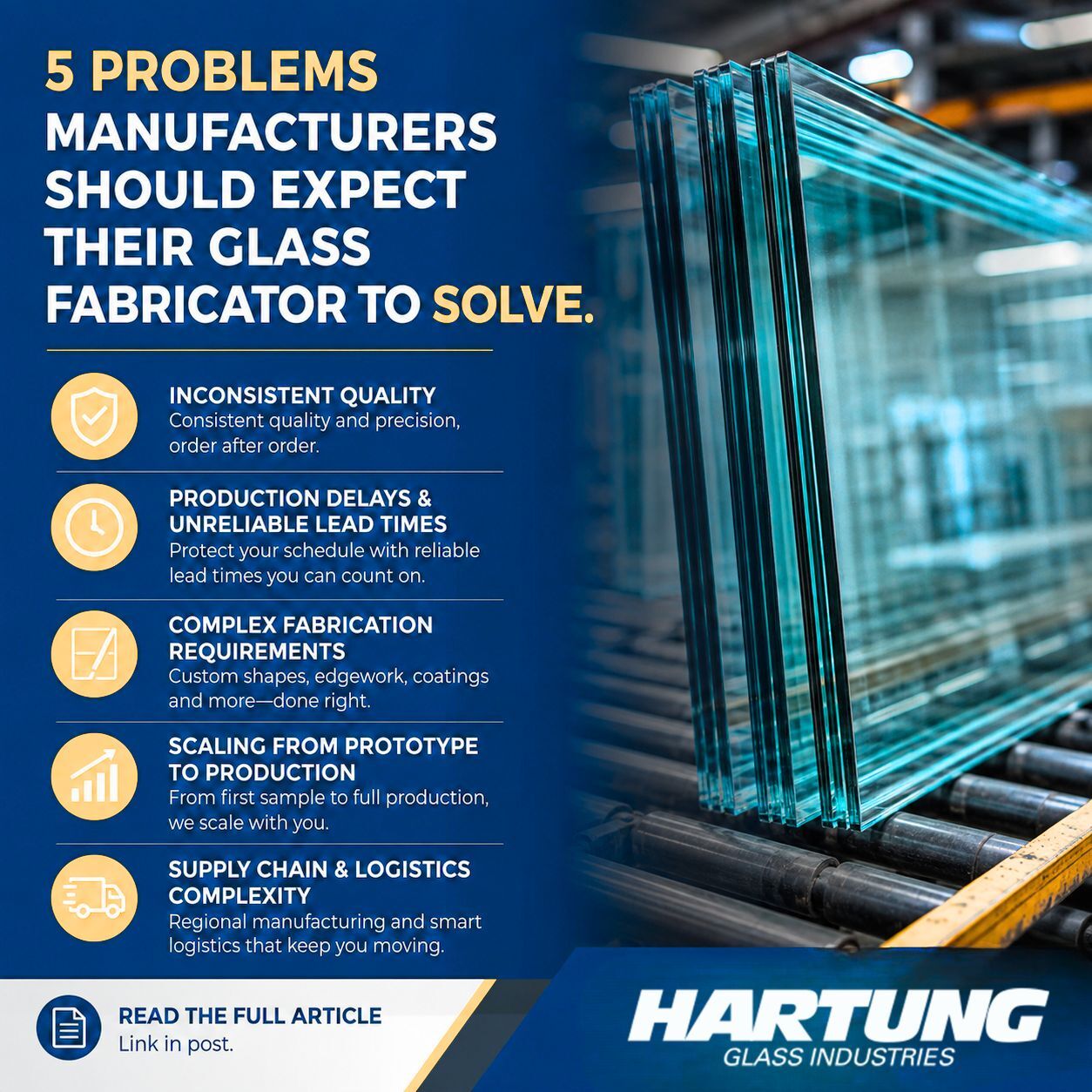
5 Problems Manufacturers Should Expect Their Glass Fabricator to Solve
When glass is a component of your finished product, your glass fabricator isn't just another vendor. They're part of your production process.
Whether you're manufacturing windows, doors, partitions, displays, furniture, shower systems, architectural products or other products incorporating fabricated glass, problems with your glass supply can quickly become your problems—production delays, inconsistent quality, excess inventory, missed shipments and unhappy customers.
A strong glass fabrication partner should do more than manufacture glass to a drawing. They should help make your operation easier.
Here are five problems manufacturers should expect their glass fabricator to help solve.
1. Inconsistent Quality
In an OEM environment, consistency matters just as much as quality.
One excellent piece of glass followed by hundreds with inconsistent dimensions, edgework, fabrication or appearance doesn't work in a repeatable manufacturing process.
Your glass fabricator should be able to consistently deliver to your specifications across production runs.
That means helping you achieve:
- Consistent dimensions and tolerances
- Repeatable fabrication
- Reliable edge quality
- Consistent appearance
- Accurate hole, notch and cutout placement
- Quality standards appropriate for your application
The goal isn't simply good glass. It's predictable glass, order after order.
2. Production Delays and Unreliable Lead Times
Your production schedule depends on your suppliers doing what they said they would do.
When glass arrives late, the consequences can extend well beyond the glass itself. Production can slow down, labor can be left waiting, finished products can miss shipping dates and customer commitments can be put at risk.
Your glass fabricator should understand your production requirements and help establish a supply program built around them.
That may include:
- Consistent lead times
- Production forecasting
- Scheduled releases
- Repeat orders
- High-volume production
- Regional manufacturing support
- Clear communication when requirements change
The right supplier isn't simply filling purchase orders. They're helping protect your production schedule.
3. Complex Fabrication Requirements
OEM glass isn't always a rectangle.
Manufactured products can require custom shapes, holes, notches, edgework, printing, coatings, tempering, laminating, insulating glass and other fabrication processes.
Working with multiple suppliers for those capabilities adds complexity.
A capable glass fabrication partner should help manufacturers determine the most efficient way to produce the glass they need—from initial specifications and prototypes through repeat production.
The more capabilities your fabricator can manage under one roof, the fewer handoffs your team has to coordinate.
Complex glass shouldn't create a complex supply chain.
4. Scaling From Prototype to Production
A supplier that can make ten pieces isn't necessarily the right supplier to make 10,000.
New products often begin with samples, prototypes or limited production runs. But if the product succeeds, your glass supply needs to scale with it.
Your fabrication partner should be able to support that progression.
That means asking questions such as:
Can they help during product development?
Can they manufacture prototypes?
Can they repeat the specification consistently?
Can they support larger production volumes?
Can they service multiple manufacturing locations?
Choosing a supplier capable of supporting both development and production can eliminate the disruption of changing glass fabricators just as a product begins gaining momentum.
5. Supply Chain and Logistics Complexity
Glass can be expensive to ship—and even more expensive when it arrives late, damaged or at the wrong facility.
Manufacturers should expect their glass partner to think beyond fabrication and consider how glass moves through the customer's operation.
A strong supplier should help evaluate:
- Manufacturing location
- Freight distance
- Packaging
- Delivery schedules
- Order quantities
- Inventory requirements
- Multiple plant locations
- Supply continuity
For manufacturers operating multiple facilities, a glass partner with a broad manufacturing footprint can be especially valuable.
Regional production can potentially reduce freight complexity while providing additional flexibility as manufacturing requirements evolve.
Your Glass Supplier Should Make Manufacturing Easier
Price will always matter.
But the lowest price per square foot doesn't necessarily represent the lowest total cost.
Quality issues, production downtime, missed deliveries, excessive inventory, freight costs and supplier management all have a cost.
That's why the better question isn't simply:
"Who can make this piece of glass?"
It's:
"Who can help us manufacture our product more efficiently and reliably?"
For more than 100 years, Hartung Glass Industries has helped customers solve complex glass fabrication challenges. With manufacturing locations across North America and capabilities including tempering, insulating glass, laminated glass, heavy fabrication, decorative solutions, digital printing and custom fabrication, Hartung can support OEM programs from prototype through production.
Looking for a Better Glass Fabrication Partner?
Whether you're developing a new product, experiencing challenges with your current supplier or simply want to understand your options, Hartung can help evaluate your glass requirements.